
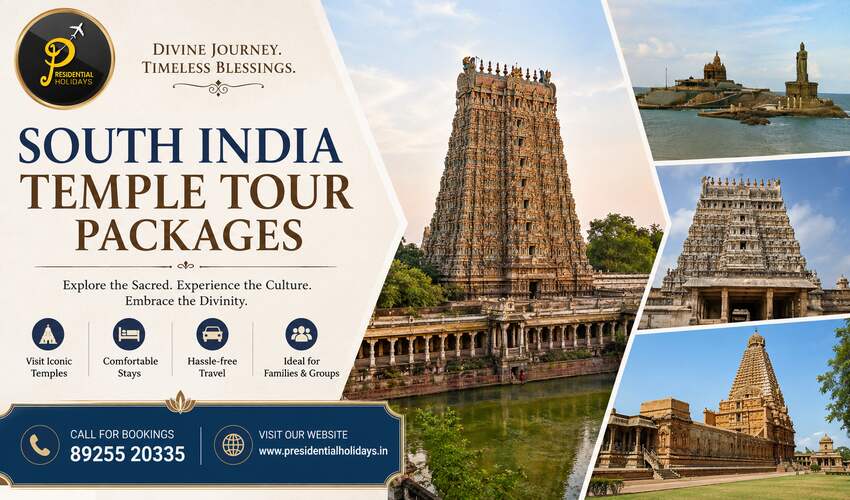
Eight days. Seven cities. Fourteen temples. One long road that started in Madurai and ended quietly in Chennai, with enough in between to keep you thinking about it long after the flight home.
This is not a highlight reel. It's what the journey actually feels like, start to finish, for anyone looking at South India temple tour packages and wondering whether it's worth the time, the planning, and the leap.
The First Morning in Madurai Tells You Everything
Madurai doesn't build up to anything. It starts at full volume.
You walk toward the Meenakshi Amman Temple through narrow streets that have been doing exactly this - feeding pilgrims, selling flowers, smelling of incense and frying oil - for centuries. And then the gopuram appears above the rooftops, all four of them, carved so densely with figures that your eye doesn't know where to land first. You stop. Everybody stops. Even people who've been here before stop.
Inside, the Hall of a Thousand Pillars earns its name. The evening aarti draws a crowd that somehow makes the space feel larger instead of smaller - the chanting, the brass lamps, the press of people who came from every corner of India for this exact moment. It's one of those rare places where the atmosphere does the work, and you're just a grateful witness.
By the time you head back to the hotel that first evening, you've already understood something about this trip: Tamil Nadu isn't going to let you stay on the surface.
Rameshwaram Sits at the Edge of Everything
The road to Rameshwaram crosses the Pamban Bridge, and for a few minutes you're suspended over open ocean with nothing but salt air and a ridiculous view. It sets the tone for what's coming.
The Ramanathaswamy Temple doesn't announce itself the way Meenakshi Amman does. It pulls you inward instead - through corridors of carved pillars that stretch so far ahead you can't see the end from the beginning. Pilgrims move slowly here, and you find yourself falling into their pace without deciding to. That happens a lot in this part of Tamil Nadu.
Dhanushkodi is the unexpected heart of this day. A town that was wiped off the map by a cyclone in 1964, never rebuilt, now just foundations and sea wind and a strange, beautiful desolation. Standing there at the tip of India, water on both sides, the coast of Sri Lanka faint in the distance - it's the kind of place that empties your head completely. No agenda. No camera anxiety. Just the wind doing whatever the wind does.
Agni Theertham is where the ocean meets the temple wall, and where a lot of people quietly take stock of things. No one tells you to. It just happens.
Trichy Surprises Everyone Who Underestimates It
People treat Trichy as a connector city between the bigger stops, and they miss something because of it.
Sri Ranganathaswamy Temple is one of the largest temple complexes on earth - not just in India, in the world. Seven enclosures, each one a world of its own, with streets and shops and a living community inside the walls. You could spend half a day here and still feel like you've only grazed it.
The Rockfort Temple is a different kind of reward. Four hundred steps up a natural rock formation, steep enough that you're breathing hard by the top, and then Trichy is below you in every direction - the Kaveri winding through it, the city stretching out flat and wide, the air noticeably cooler than it was at the bottom. The climb earns the view, which always makes a view mean more.
Thanjavur Is Where You Run Out of Adjectives
Nothing quite prepares you for the Brihadeeswarar Temple.
It was built over a thousand years ago. The central tower is 66 metres tall. The capstone weighing 80 tonnes sits at the top, and engineers today still debate the exact method by which the Chola builders raised it without any of the equipment we'd consider necessary. You stand below it and the math doesn't work, and then you realise the math was never the point. The point was faith applied at architectural scale.
It's a UNESCO World Heritage Site, but that label actually undersells it. This is a living temple, not a monument - prayers happen here every day, as they have for a thousand years. That continuity is what gets you. The same stone floors, worn smooth by a millennium of bare feet.
The Thanjavur Palace and Saraswathi Mahal Library nearby add a quieter kind of richness - a dynasty that built beautifully and read voraciously, and left both behind for anyone curious enough to look.
Kumbakonam, Chidambaram, and the Temples That Ask More of You
Kumbakonam the next morning feels unhurried in a way that's almost startling after the previous days. A proper temple town, where the temples are folded into the streets rather than standing apart from them. Adi Kumbeswarar, Sarangapani, the underrated Airavatesvara Temple - another UNESCO site that deserves three times the attention it gets. The Navagraha circuit, visiting all nine celestial temples in one loop, is optional but quietly unforgettable for anyone even slightly drawn to that tradition.
Then Chidambaram, and the Nataraja Temple, which operates on a completely different frequency to everything that came before. Shiva as the cosmic dancer - not static, not resting, but caught in eternal motion - is the central image here, and the temple is built around the tension between movement and stillness. It's the most philosophically layered space on the entire route, and it stays with you longer than most.
Mahabalipuram Changes the Language Entirely
Somewhere on the route from Chidambaram to Chennai, the architecture shifts. The Pallava dynasty carved their temples directly from rock - no assembly, no brickwork, just subtraction. Rock removed until a temple remained.
The Shore Temple at Mahabalipuram stands right at the Bay of Bengal's edge, the waves close enough to hear from inside. It's a thousand years old and it looks like it belongs exactly there, which is a strange and lovely quality in a building. Arjuna's Penance - the massive open-air rock relief - is something you walk past several times and keep finding new figures in. The Pancha Rathas, five monolithic temples each carved from a single boulder, has a kind of quiet confidence about it. Nothing is trying too hard. Everything is already exactly what it needs to be.
Chennai Closes the Loop
By the time you reach Kapaleeshwarar Temple in Mylapore, the last major shrine on the route, there's a different kind of attention you bring to it. Eight days of practice. Seven cities are slowly learning how to stand in old spaces. The temple is beautiful and the surrounding neighbourhood is one of Chennai's most atmospheric - it earns a long morning.
Santhome Basilica, a few kilometres away, built over the tomb of St. Thomas the Apostle, is a reminder that this coastline has been a meeting point of faith for two thousand years in more than one tradition. Marina Beach at dusk, the longest urban beach in India, is where you let the last few days settle.
The Part That Made It Work
None of this happens cleanly without the right support underneath it.
Presidential Holidays planned and managed this entire route - accommodation, transport, meals, and guides at every stop - and the difference it makes is hard to overstate. They're based in Madurai, which means this isn't theoretical knowledge for them. These are their roads, their temples, their region. That local fluency shows up in ways you only notice in retrospect: the temple you visited at 7am before the crowds arrived, the route that avoided the afternoon traffic, the meal stop that turned out to be the best food of the trip.
South India temple tour packages vary enormously in how much they actually think through the experience versus how much they just connect the dots on a map. Presidential Holidays falls clearly in the former category. The package starts at ₹76,800 per person for eight days and seven nights, covering the full circuit from Madurai to Chennai with all logistics included.
